
Apple App Store Milestone: How to Pool iPhone and iPad RAM to Run 30B AI Models at Home
In an industry first, consumer smartphones are no longer passive web clients. Discover how RAMDeck Distributed AI enables iPhones and iPads to contribute unified RAM and Metal GPU shaders to local inference clusters.
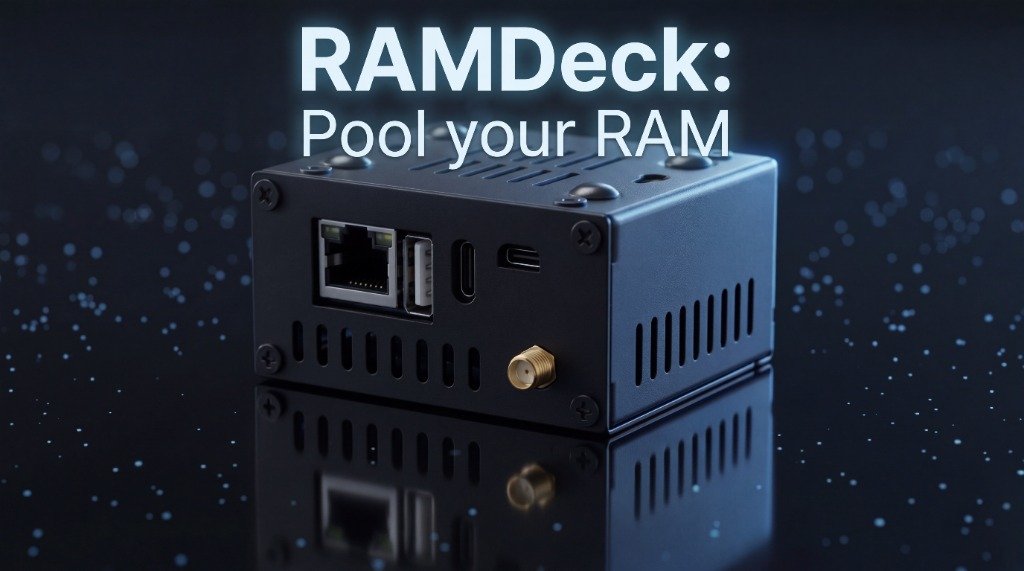
The End of the “Hardware Island”
In local artificial intelligence inference, memory is a binary constraint: either an AI model fits entirely within available RAM, or it aborts with an instant Out of Memory (OOM) error. If your workstation has 16 GB of RAM and a quantized 30B parameter model requires 18 GB, you are dead in the water.
Until today, the only options were purchasing enterprise-grade workstation GPUs (costing $1,500 to $2,500) or paying monthly API subscription fees to cloud providers. Meanwhile, billions of gigabytes of ultra-high-speed Apple Silicon unified memory sit completely idle on nightstands and desk docks every night.
RAMDeck Distributed AI solves this fundamental mismatch. Officially approved and live on the Apple App Store, the RAMDeck companion app transforms your iOS devices into active, distributed co-processors that contribute their memory and GPU compute to your local network.
Why Metal on iPhone Outclasses Legacy PCs and Androids
Past community attempts at distributed computing often suffered severe latency bottlenecks because worker nodes evaluated layers on slow CPU threads. When remote CPUs evaluate transformer tensors, network transfers and low memory bandwidth throttle token generation down to an unworkable 1 to 2 tokens per second.
Apple Silicon changes the physics of distributed inference entirely:
| Hardware Class | Compute Pipeline | Memory Bandwidth | Distributed Latency Impact |
|---|---|---|---|
| Legacy DDR3/DDR4 PC | Software CPU Threads | 15 – 25 GB/s | Severe bottleneck (1–2 tok/s) |
| Budget Android Phone | ARM CPU Cores | 18 – 28 GB/s | Thermal throttling & slowdowns |
| iPhone / iPad (A17/A18/M-Series) | Apple Metal 3 GPU Shaders | ~60 – 68 GB/s | Real-time interactive generation |
Live Tested Evidence: Sharding Across a MacBook & 2 iPhones
In verified benchmark testing, an 18GB Qwen 30B model that exceeded the physical memory of a single MacBook M3 was sharded over local Wi-Fi:
- MacBook M3: Hosted graph coordination and initial transformer layers (~14 GB).
- iPhone 16: Contributed ~3.2 GB of active Metal GPU memory over Wi-Fi.
- iPhone XS: Contributed ~1.0 GB of spillover memory.
The entire distributed model loaded in under 30 seconds, generating tokens at 28 tok/s with first-token turnaround in under 5 seconds with zero cloud dependencies.
🎥 Watch the Verified Video Demos
▶ MacBook + 2 iPhones Running Qwen 30B: Watch Video Demo
▶ iPhone 16 Live Pause & Resumption: Watch Live Demo
100% Air-Gapped Data Sovereignty
Apple’s strict App Store review confirmed that zero bytes of personal data, telemetry, or model activations leave your local Wi-Fi network. There are no account logins, cloud relays, or subscription paywalls.
For professionals bound by strict confidentiality standards—including law firms adhering to ABA Formal Opinion 512 and healthcare providers—this enables private local deployment of frontier models without cloud compliance risk.