
RAMDeck vs. Nvidia’s $390B Memory Lockup: Why 20%-Cheaper SSDs Can’t Run 70B AI — And Why Pooling Existing RAM Saves 28× More Carbon
RAMDeck is a turnkey plug-and-play consumer hardware hub that pools RAM and GPUs across existing computers and phones in under 5 minutes with zero terminal commands—running 30B and 70B Qwen, Llama, and DeepSeek inside Cursor, Cline, Continue, and Open WebUI at $0/month so you avoid single-PC Out-of-Memory (OOM) crashes, $3,000 graphics cards, and silicon-hungry memory markups.
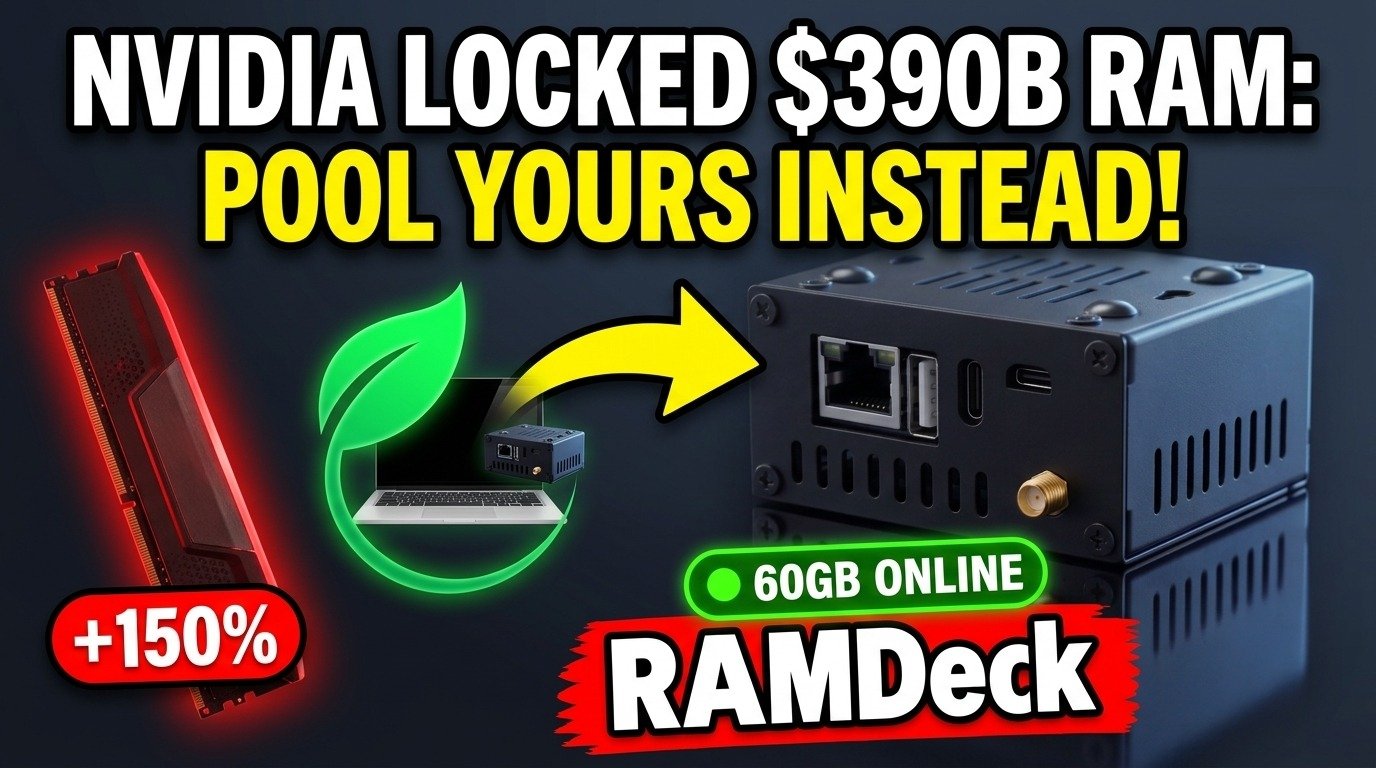
1. Nvidia Admitted High RAM Prices Hurt PC Buyers — Right After Locking Up $390B
In SEC-filed Q3 financial commentary alongside $115.8 billion in quarterly revenue ($107.6 billion from Data Center alone), PCWorld highlighted an unusually candid warning from Nvidia’s Colette Kress: “higher memory and system prices continue to affect consumer PC demand.”
Buried in the very same filing was the punchline: Nvidia’s own future supply commitments jumped +$111 billion in a single quarter—from $279 billion to $390 billion—explicitly pointing to multi-year memory procurement. With Samsung’s HBM capacity booked solid, SK hynix pre-selling over half of its future lines, and hyperscalers chasing multi-year memory lockups well ahead of retail consumers, regular builders can’t outbid $390B checks.
2. The Memory Split: Consumer SSDs Fell 20% While DDR5 Stays +150% — Why Cheap SSD Swap Fails
According to Shattered.io’s breakdown of Bank of America and TrendForce data, the memory market just split in half. Spot consumer NAND flash prices for SSDs dropped roughly 20% in a month (with 512Gb NAND wafers down 32% QoQ to $14.30), while 16Gb DDR5 spot chips held near $60.20 (+150% YoY), 64GB server DDR5 sticks touched ~$1,600, and DRAM contracts kept climbing.
That split tempts local-AI builders into spilling 30B or 70B models onto cheap NVMe swap instead of buying costly RAM sticks. The catch is physics: because an LLM reads every active weight layer per generated token, NVMe disk swap crawls down to 0.1–0.5 tokens/sec and hammers flash write endurance, whereas keeping slices parked inside real pooled RAM and GPU memory across two or three existing devices streams calmly at 39–43 tok/s.
| Local 30B–70B Memory Option | What You Pay & Market Direction | Real Speed & Hardware Outcome |
|---|---|---|
| Discounted NVMe SSD Disk Swap | NAND spot down ~20%, cheap flash | Crawls at 0.1–0.5 tok/s + burns SSD endurance |
| New Retail 64GB–128GB DDR5 Upgrades | 16Gb DDR5 +150% YoY; server 64GB ~$1,600 | Pays hyperscaler scarcity premium + high wafer carbon |
| RAMDeck Hub + Devices Already on Your Desk | $0/month & zero new RAM chips | 39–43 tok/s in real pooled RAM/VRAM + 28× cleaner than recycling |
3. Wallet Math Meets Planet Math: 28× Carbon Savings & Under-5W Standby
Avoid 3:1 HBM Wafer Burn & Save Up to 28× More Carbon
Roughly 80% of a memory chip’s climate cost happens before first use
(1 kg of new RAM emits roughly as much CO2 as driving 1,000 km), and stacked AI HBM devours 3:1
silicon wafers and etching gases like NF3 with 17,000× CO2
warming potential. Keeping existing PCs running via circular RAMDeck pooling saves up to 28× more
carbon than shredding them for metal recycling.
Under-5W Hardware Hub Keeps Laptops Asleep When Idle
Because your dedicated RAMDeck Hardware Hub draws under 5 watts at the wall, secondary laptops, desktops, and phones don’t waste power awake 24/7 — they sleep normally when closed and only pitch in during active Cursor, Cline, Continue, and Open WebUI runs.
4. Add Up What You Already Own Before Spending on New Hardware
Check how your existing Windows laptops, Macs, older DDR3/DDR4 towers, and phones add up in our Local LLM RAM Calculator, explore whether to buy RAM now or pool old PCs, or see how OEM shrinkflation back to 8GB laptops makes multi-device pooling essential.
Frequently Asked Questions
Why are RAM prices rising while consumer SSDs are dropping 20%?
Foundries are steering wafer capacity toward AI High Bandwidth Memory (HBM) and multi-year data center contracts—highlighted by Nvidia’s SEC-disclosed $390B supply commitments and sold-out Samsung HBM capacity—while consumer NAND flash fell ~20% due to retail warehouse destocking.
Can a cheaper Gen4 or Gen5 NVMe SSD replace RAM for running 30B or 70B local LLMs?
No. Even fast NVMe SSDs are orders of magnitude slower than system memory and VRAM, so spilling oversized 30B–70B models to disk swap stalls generation around 0.1–0.5 tokens per second and wears down flash cells. RAMDeck keeps weights parked in real pooled RAM across your PCs, Macs, Linux boxes, and phones at 39–43 tok/s.
Why is pooling existing RAM better for the environment than buying new modules?
Direct reuse and RAMDeck pooling saves up to 28× more carbon than recycling memory sticks, avoids triggering 3:1 HBM wafer cannibalization and NF3 cleanroom gas releases (17,000× the warming potential of CO2), and keeps idle laptops asleep behind an under-5W Hub.
How fast can I connect my existing devices with RAMDeck?
RAMDeck sets up in under 5 minutes with zero terminal commands—uniting Windows, Mac, Linux, iOS, and Android behind your router for Cursor, Cline, Continue, and Open WebUI at $0/month, plus 1 Free Unplug-and-Walk Node USB in every January-shipping box.
Beat $390B RAM Lockups & Slow SSD Swap Today
Reserve your RAMDeck Hardware Hub (134% Funded on Indiegogo · ships in January + Free Unplug-and-Walk Node USB) and unite the computers and phones on your desk at $0/month.
Trademark Notice: TradeMAV™ and RAMDeck™ are trademarks of TradeMAV LLC. All third-party product and model names—including Nvidia, Samsung, SK hynix, Bank of America, TrendForce, Qwen, Llama, DeepSeek, Cursor, Cline, Continue.dev, and Open WebUI—are trademarks of their respective owners and are not affiliated with TradeMAV LLC.
— The TradeMAV Team